Follow us

Annual General Meeting 2026
Our Annual General Meeting is a chance for our members to hear how the Irish Kidney Association is working on your behalf. We’ll share updates on services, advocacy, organ donation awareness and plans for the year ahead.
11am on Saturday, 4th July 2026
Aspect Hotel, Park West, Nangor Road, Dublin D12 F2V4
POST-AGM UPDATE
We are delighted to share that the votes to update our Constitution, as described in the ‘Summary of Constitutional Changes‘ and ‘The Board Restructuring Explained‘ documents below, were passed by an overwhelming majority of members at the AGM on 4 July 2026. We are now working with our external Legal Counsel to update the Constitution and file it with the appropriate authorities.
With regard to the operational structure of our Board, we are now in the ‘Transition Period’, where our current Board will work alongside new Directors elected from the pool of Member Forum Branch Representatives to ensure stability and consistency for the Association while the new structure is being implemented. You can read more about the transitional arrangements in the ‘Board Transition Explained‘ document below.
We’d like to take this opportunity to thank our Board, staff, and members for their time, patience and commitment to this project. As we look to the future, we’re excited that these changes will ensure we meet our legal obligations, while improving efficiencies and keeping the patient voice at the heart of everything we do.
AGM GOVERNANCE
2026 AGM Agenda
Annual Report 2025
Minutes of the 2025 AGM
Voting by proxy
If you are unable to attend the AGM in person, you may appoint a proxy to vote on your behalf. Please complete and return the proxy form by 26th June 2026
FUTUREPROOFING PROJECT
Further Information on the Proposed Constitutional Changes
Futureproofing the IKA: The AGM Vote Explained
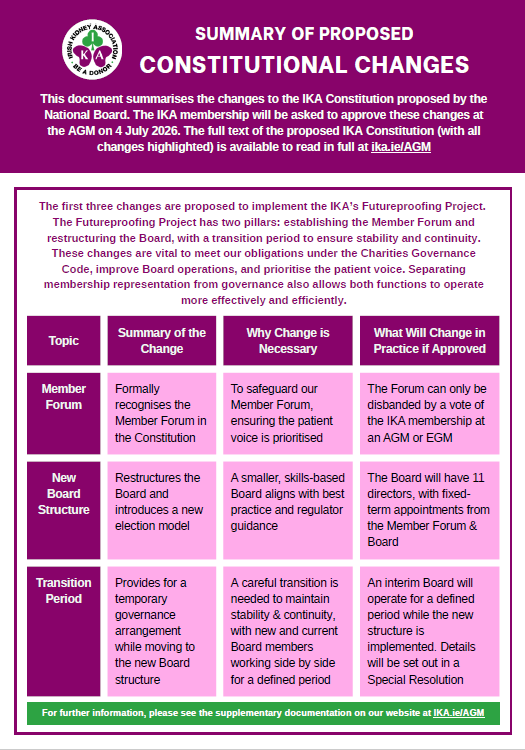
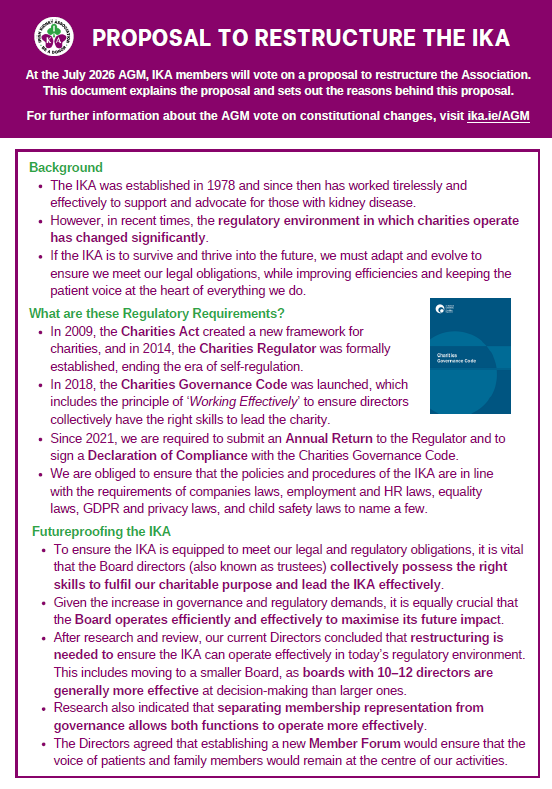
At this year’s AGM, members will be asked to vote on a proposal to futureproof the IKA. The proposal includes changes to how the Board operates, measures to safeguard our National Member Forum into the future, and a small number of other changes to improve how we operate. To implement these changes, updates to the IKA Constitution are required which must be approved by members.
Webinar: Futureproofing the IKA: The AGM Vote Explained
On Monday evening, 22nd June, the IKA hosted a Zoom webinar to explain all of the proposed constitutional changes and to answer members’ questions.
Summary of Constitutional Changes
The Board Restructuring Explained
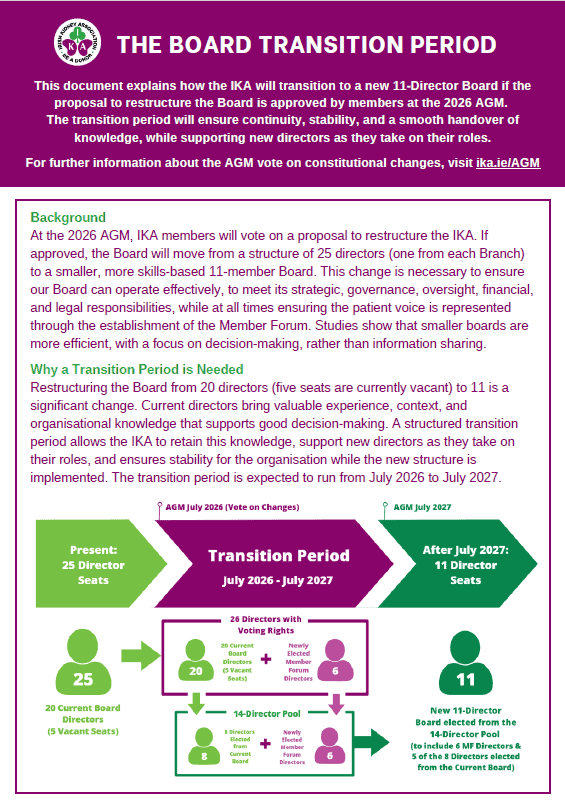
The Board Transition Explained
Proposed IKA Constitution
Three Special Resolutions
Charities Governance Code
FREQUENTLY ASKED QUESTIONS
In short, the rules in which charities in Ireland operate have fundamentally changed. Our Board structure needs to evolve to remain compliant and effective, not because the current system failed, but because the requirements have grown.
Good Governance: When the IKA was founded in 1978, there was no dedicated charities regulator. Today, the Charities Regulator is an independent statutory body with legal powers to investigate and sanction boards for non-compliance. The era of self-regulation is over. The Charities Governance Code 2018 must be complied with, and it requires every board to conduct skills audits and prove collective competence. A 25-person board with branch-nominated members cannot credibly make that declaration.
Finance: Our current structure is also not attractive to institutional investors and major donors, meaning we are potentially losing funding opportunities. Additionally, we cannot meet the compliance obligations required to be awarded certain grants without a fit-for-purpose governance framework.
Reputation: Recent scandals in the charities sector, where boards lacked oversight of finances and failed to manage conflicts of interest, have damaged public trust in charities. The Regulator has stated that governance issues remain its single biggest concern. Directors also face personal legal liability; annual reports must be filed on time, and failure is an offence for the charity and individual board members.
The old model worked then, but the law has changed. This restructuring is not about fixing something that is broken, it is about ensuring IKA can legally meet today’s regulatory requirements, not those of 1978, and work as effectively and efficiently as possible to best serve our members and those affected, and likely to be affected, by kidney disease throughout Ireland.
In the long term, these changes are designed to make the IKA stronger, more sustainable, and more effective. The aim is not just to improve how the organisation is run, but to ensure it can deliver stronger, more impactful support for patients both now and into the future.
Overall, the changes will help the IKA to:
Ensure the Board has the right skills, leading to stronger decisions, better oversight, and more effective use of resources
Place the patient voice at the centre of the organisation, through a dedicated Member Forum that directly shapes strategy and Board appointments
Provide more consistent and accountable leadership, with a structure designed to support active participation and engagement
Strengthen the IKA’s influence and credibility, enhancing its ability to advocate, campaign, and engage with healthcare services and Government
Build a more resilient and future-ready organisation, better equipped to grow, adapt, and meet the changing needs of patients.
These changes are designed to place patients and their needs at the heart of everything the IKA does. The introduction of the Member Forum creates a dedicated space where patient experiences, concerns and priorities can be discussed in depth, ensuring they directly shape the organisation’s strategy, policies and decisions. This is further strengthened since six of the 11 Directors will be elected from the Member Forum.
At the same time, a smaller, skills-based Board ensures that decisions about services, funding and priorities are made effectively and in the best interests of patients. By having the right mix of skills and experience at Board level, the IKA can plan services more strategically, use resources more efficiently, and respond more quickly to emerging patient needs.
Yes, these changes are expected to support both growth and fundraising. Stronger governance and a more skills-based Board will improve how the organisation is managed, planned and overseen. This is important for funders, regulators, funding bodies, and partners, who increasingly expect charities to demonstrate strong accountability, transparency and professionalism.
At the same time, having a clear structure that separates governance from patient representation means the IKA can be more strategic and effective in how it develops services and campaigns. The Member Forum ensures that this growth remains grounded in real patient needs.
Together, these changes will help strengthen the IKA’s credibility and reputation, making it better positioned to secure funding, build partnerships, and have a stronger voice when engaging with healthcare services and Government.
It’s understandable that the increased focus on governance, finance and compliance might feel more ‘corporate’. However, these responsibilities are not optional. As a registered charity and company, the IKA is legally required to meet a wide range of regulatory and governance standards, including complying with the Charities Governance Code, company law, financial reporting requirements, and other legal obligations. This means the Board must dedicate time and resources to areas such as oversight, risk management, and compliance to ensure the organisation is operating responsibly and can continue to serve members into the future.
That being said, the proposed ‘futureproofing project’ changes are specifically designed to protect and strengthen the patient voice. The Member Forum was created to provide a dedicated national space where members’ experiences, concerns and priorities can be fully explored and represented. Each branch will have a representative on the Member Forum, and it will play an active role in shaping strategy, influencing policy, and appointing six members of the Board.
So while the Board’s role is becoming more focused on governance, the Member Forum ensures that the patient perspective is not diluted. In fact, it is given a clearer, stronger platform within the organisation.
If approved by members at the 2026 AGM, the changes will be introduced in phases:
4 July 2026 (AGM): Members vote on the proposed constitutional changes.
July 2026 – July 2027: A one-year transition period begins. During this time, the current Board continues in place alongside newly appointed Directors, allowing for continuity and knowledge transfer. Note there is a separate section of these FAQs which answers questions on the transition period.
July 2027 (AGM): The transition period ends and the new 11-director Board structure is fully implemented.
After this, the Board will operate on a rolling basis, with Directors rotating gradually over time rather than all changing at once.
We have taken a range of steps over an extended period to ensure members are informed and have opportunities to engage with the proposed changes.
We first introduced the Futureproofing Project in articles in our Support magazine from Summer 2024 onwards, keeping members updated as the proposals developed.
We created a dedicated webpage on the Member Forum at ika.ie/memberforum to explain its purpose and role, along with instructions on how to elect your branch representative.
We held presentations for Branch Officers and Member Forum representatives on a number of occasions to explain the proposals and gather feedback.
We developed summary documents and supporting materials, which are available on the AGM webpage at ika.ie/AGM.
We shared updates through IKA social media channels to reach members more broadly.
Upon request, we attended branch meetings to explain the proposals and answer members questions.
In advance of the AGM:
All members will be contacted directly by email or post, with details of the AGM and the proposed constitutional changes, and directed to the AGM webpage for full information.
We will also host a live webinar in late June, where members can hear a full presentation on the changes and take part in a Q&A session.
Overall, the aim has been to provide clear, accessible information through multiple channels, and to give members every opportunity to understand the proposals and ask questions before voting.
If you are unable to attend the AGM in person, you can appoint a proxy to attend and vote on your behalf by completing a proxy form. You can download the proxy form via the Download button above. Simply fill in the form with your details and nominate a member to act as your proxy.
Once completed, the proxy form must be submitted in advance of the deadline specified on the proxy form. Your proxy will then be authorised to vote in accordance with your instructions at the meeting.
If the proposals are not approved, the current structure will remain in place for now. However, the Board has already identified clear limitations with the existing structure, including gaps in key skills and increasing demands around governance, compliance and oversight. In simple terms, continuing as we are today is not a sustainable long-term option.
This proposal is the result of several years of work, including research, expert input and careful design, to create a balanced model that strengthens both governance and the patient voice. It is intended as a comprehensive solution to the challenges the IKA is facing.
If it does not pass, the Board will need to revisit the issue and develop alternative proposals. This process would take significant time and resources, time that could otherwise be spent delivering services and supports for patients, and may ultimately lead to similar or further changes being brought forward in the future.
Importantly, the regulatory and operating environment for charities continues to evolve. Delaying change increases the risk that the IKA may face greater challenges in meeting its obligations, maintaining its effectiveness, and sustaining its impact.
In summary, while the work could be revisited, meaningful change will still be required. Approving these proposals now allows the IKA to move forward with a well-developed, carefully considered model, rather than delaying necessary improvements and risking greater challenges in the future.
Research and governance experts consistently identify 10 to 12 members as the optimal size for an effective, high-functioning board. Once a board grows beyond 12 directors, significant inefficiencies emerge: decision-making slows, coordination becomes difficult, and individual directors can feel their contributions are diluted. Efficiencies also slow, with resources spent on information sharing rather than decision-making. The 11-director target sits comfortably within the optimal range identified by studies of both non-profit and corporate boards.
This also aligns directly with our regulatory obligations under the Charities Governance Code principle of “Working Effectively”, which requires us to demonstrate that our board has the collective skills to lead the charity and that our structure enables good governance. An 11-director board is small enough that every director has meaningful participation, yet large enough to avoid the risks of a very small board, such as individual dominance or trustee burnout.
No. All IKA Board directors, offer their time and expertise on a voluntary basis. They may receive expenses from time to time in accordance with IKA policies, such as travel and subsistence. This is also the case for Branch Officers and Member Forum Representatives asked to attend meetings in person.
After the transition period, the Board will have 11 Directors, appointed in two ways:
Member Forum Directors (6 seats):
The Member Forum will appoint six Directors, one from each of the six HSE regions. Representatives from each region may put themselves forward for election as the Director representing their HSE region. All members of the Member Forum will vote in each of the six elections. This process ensures strong patient and regional representation. If the Member Forum fail to appoint a Director from one or more of the six HSE regions, the Board will appoint a Director, taking geographic representation and skills requirements into account.
Board-appointed Directors (5 seats):
The Board will appoint the remaining five Directors. These will include three IKA members and two external individuals, chosen to ensure the Board has the right mix of skills, diversity, and experience.
In advance of the elections, candidates will be asked to circulate a written submission (no longer than 1 page). They will be given the opportunity to give a verbal ‘pitch’ at the election meeting (no longer than 5 minutes). This is not mandatory. The vote will then take place.
All Directors are elected for a three-year term (the term was previously two years) and may be reappointed. Elections are then formally ratified at the AGM so members are informed and can see who is serving on the Board.
To ensure continuity, after 2028, Directors will retire on a staggered basis each year, rather than all at once. When a position becomes vacant, the relevant nominating body (Member Forum or Board) selects a replacement.
Both Member Forum Directors and Board-elected Directors must do their best to elect individuals with the necessary skills to meet the IKA’s regulatory requirements.
Note that non-member Directors will only be appointed by the Board to positions as relevant vacancies arise or from the 2028 appointment cycle onwards. This is to allow the new 11-seat Board time to settle and establish itself during its first year.
Yes. This was a priority for the Board when designing the Futureproofing Project. Here’s how they addressed it:
6/11 Directors come directly from the Member Forum which represents patients, their families and others with lived experience of the Irish Healthcare system;
The Member Forum continuously feeds patient insights into Board decisions; and
IKA staff involved in patient services, patient advocacy and volunteer management are members of the Member Forum.
Yes. The proposed changes include an adjustment to the term of office for Board Directors from two years to three years. This change will only take effect if they are approved by members at the 2026 AGM.
Yes. Smaller boards are proven to be more efficient and focused on decisions rather than discussion and information sharing.
Yes, but this is intentional. To ensure we meet our regulatory obligations, Directors must meet experience, tenure, and skills requirements.
The Board is not focused on formal qualifications alone, but rather on the skills, experience and perspectives that individuals bring, whether through professional roles, volunteering, or lived experience. Rather than expecting every Director to have all of the 31 skills identified by the Board, the focus is to ensure they are collectively covering a broad range of areas, including:
Lived experience: including patients, family members, carers, and those involved at branch level
Governance and leadership: experience in strategy, decision-making, compliance and organisational oversight
Professional expertise: such as finance, legal, HR, IT, communications and risk management
Healthcare and patient insight: including knowledge of the healthcare system, renal care, and service delivery
Advocacy and growth: skills in fundraising, campaigning, partnerships, and business development
This approach ensures that the Board is both professionally equipped to run a modern charity and grounded in the real experiences of patients and members.
No. It has real influence:
The Member Forum will elect six of its branch representatives to the Board of Directors
The Member Forum inputs into strategy and policy. In fact, later this year, members will be joining strategy discussions, with an external facilitator, to provide input into the next IKA Strategic Plan (2027-2031).
Members will represent patient experiences in a formal capacity. Its role is deliberately structured to be influential without carrying legal governance risk.
The Board (with Member Forum agreement) sets the Terms of Reference that governs how the Member Forum operates. Those Terms state that the Forum will be made up of no more than 35 members, including 25 branch representatives, certain IKA staff, and experts as required.
IKA staff members include our CEO, patient services manager, advocacy manager, volunteer and development manager and a facilitator. The CEO and facilitator are non-voting members. Additional non-voting members (e.g. medical or policy experts) may be invited to join from time to time. This helps balance lived experience with expertise.
If the vote is passed, the existence and core role of the Member Forum will be constitutionally protected. The Board will have the ability to make changes to the Terms of Reference that govern the Member Forum, however they can only do this in agreement with the members of the Member Forum.
The Member Forum and the Board have complementary roles, designed to ensure both strong governance and a strong patient voice.
The Member Forum will focus on patient experience. It will carry out in-depth discussions (‘deep dives’) on key patient issues, drawing on the lived experience of its members, feedback from branches across the country, and expert input as needed. The Forum will then report to the Board every six months, setting out its findings and recommendations.
The Board is required to consider this input when making decisions. This ensures that patient perspectives are directly influencing strategy, policy and priorities. The Member Forum also appoints six of the eleven Board Directors, meaning over half of the Board comes directly from this group. This creates a strong and ongoing link between the Forum’s work and Board decisions.
It is important to emphasise that the Board retains legal responsibility for the organisation and is ultimately accountable for all decisions.
If the proposals are not approved, the current structure will remain in place for now. However, the Board has already identified clear limitations with the existing structure, including gaps in key skills and increasing demands around governance, compliance and oversight. In simple terms, continuing as we are today is not a sustainable long-term option. This proposal is the result of several years of work, including research, expert input and careful design, to create a balanced model that strengthens both governance and the patient voice. It is intended as a comprehensive solution to the challenges the IKA is facing. If it does not pass, the Board will need to revisit the issue and develop alternative proposals. This process would take significant time and resources, time that could otherwise be spent delivering services and supports for patients, and may ultimately lead to similar or further changes being brought forward in the future. Importantly, the regulatory and operating environment for charities continues to evolve. Delaying change increases the risk that the IKA may face greater challenges in meeting its obligations, maintaining its effectiveness, and sustaining its impact. In summary, while the work could be revisited, meaningful change will still be required. Approving these proposals now allows the IKA to move forward with a well-developed, carefully considered model, rather than delaying necessary improvements and risking greater challenges in the future.
Firstly, it’s important to highlight that the role of your Member Forum branch representative is not to resolve individual patient issues for branch members. Instead, their role is to gather patient concerns from their branch to bring to Member Forum meetings. Together, the Forum members will discuss patient concerns from across the country, choose which concerns should be priotitised for the benefit of our members, and report their findings to the Board.
Member Forum meetings will also serve as an opportunity for branch representatives to share their experiences at local level, including what issues have arisen in their area, and what actions they took to address them. The goal here is to use the Forum as a space for branches to support each other and offer advice and share experiences.
It’s worth highlighting that IKA members will continue to have the opportunity to access support through their fellow branch members at meetings or in WhatsApp chats, or by contacting the Patient Services team at Donor House who can provide access to IKA services, including counselling, peer support, financial support, holidays, and other supports.
To conclude, the Member Forum is relatively new forum. At this early stage, IKA staff are facilitating meetings and setting agendas to help build the foundations. By the end of 2026, the Forum will have elected a Chair and Deputy Chair to lead the Forum over the coming years. It will up to the Member Forum to choose what they want to focus on and what processes they want to put in place to ensure they have the most impact for patients and IKA members. If you have any suggestions on how the Forum can best achieve its goals, please reach out to your branch representative to discuss.
This is to avoid sudden loss of knowledge and to ensure continuity. Governance responsibilities are complex, and a phased transition allows new and existing directors to work together.
The purpose of the Transition Board is to allow the six new Member Forum-elected Directors to work alongside the current 20 Directors to ensure continuity of experienced directors, onboarding of the new Directors, and a smooth knowledge transfer before the new 11-seat Board is appointed.
Some have queried why a 14-Director Pool will be created at the start of the Transition Period. After all, all 26 Directors will have the same rights and responsibilities during the Transition Period.
The Director Pool helps manage the transition from 20 current Board Directors down to five Board-elected Directors after the 2027 AGM. Instead of electing only five Directors after the 2026 AGM (which risks having to replace someone who unexpectedly leaves), the Board will elect eight Directors. These eight form a pool from which the final five will be chosen to sit on the new 11-seat Board by the directors in the 14-Director Pool.
This also gives the new Board time to settle in together during the Transition Period.
No. The purpose of the Transition Period is to allow the current Directors to work with the six new Member Forum elected directors to share experience and knowledge and for continuity purposes.
To ensure a smooth transition to the new 11-Director Board, the Board have decided not to appoint any external / non-member Directors until after the 2028 AGM. At this stage , they will also have a better idea where the skills gaps lie and what skills or diversity requirements will need to be filled by the external Directors.
No. All core rights remain. Members will still have voting rights at AGMs and can still hold leadership roles. Some processes will be streamlined (e.g. online membership applications and membership approval) for efficiency.
Ordinary Members (also known as non-patient members) will now be able to vote after one year of membership. Previously they had to wait three years.
This is a valid concern, and the Board took it very seriously when designing the Futureproofing Project. The IKA has always been a member-led organisation, and the Board was determined that this had to remain a priority. That is exactly why they proposed a two-pillar approach: the first pillar is the new 11-seat Board; the second pillar is a new patient or ‘National Member Forum’.
Under the new structure, every branch will have a representative on the Member Forum. The Forum will focus on patient issues around the country, leaving the Board time to focus on governance, oversight and strategy, which is what the Charities Governance Code requires of a board.
Your branch voice will still be heard at Forum level, and that voice will directly shape IKA’s priorities. The Forum will vote on which patient issues they want the IKA to tackle and will provide input into the Board on strategy and policy.
Crucially, the Member Forum will nominate six of its 25 members – one from each of the six HSE Regions – onto the 11-seat Board. That means the patient voice will not only remain at the heart of the IKA but will represent a majority of Board members. Your nominated representative will also be free to focus on patient issues that matter at branch level, rather than being weighed down by governance and administrative paperwork, which is what the Board must concern itself with under the law.
Branches won’t lose influence at national level if the changes are approved by members, but the type of influence is changing. Instead of influencing governance decisions directly via Board seats, branches will influence patient priorities, advocacy, and strategy through the Member Forum, which then reports to the Board. The Member Forum also appoints six Directors to the Board.
The aim is to shift branch influence to where it matters most, being patient voice and services, while ensuring governance decisions are made by a smaller, skills-based Board.
Geographic representation remains an important part of the new structure, but it is organised differently. Each branch will continue to have a voice by appointing a representative to the Member Forum, ensuring that every area is represented at national level.
The Member Forum then elects six Directors to the Board, one from each of the six HSE regions. This ensures that geographic representation is maintained at Board level, but in a more balanced way, reflecting regional rather than individual branch representation.
This approach also allows local issues to be considered collectively at Member Forum level, where representatives from all branches can share experiences, identify common challenges, and agree priorities before they reach the Board. In turn, this helps ensure that decisions at Board level are informed by a broader, more coordinated national perspective, rather than being driven by individual branches in isolation.
The intention is the opposite. The Member Forum creates a dedicated space specifically for member voices, rather than competing with governance, legal, and financial discussions at Board level.
Under the current structure, Board meetings must cover a wide range of complex responsibilities, which can limit the time available to fully explore patient and branch issues. The Member Forum addresses this by creating a national platform where these issues are the sole focus, allowing for more in-depth discussion and stronger collective input.
Each branch will be represented through the Member Forum, ensuring that local perspectives are heard at a national level. In addition, the Forum plays a direct role in decision-making by helping to shape strategy and policy, and by appointing six of the eleven Board Directors.
Branch operations themselves remain unchanged.
Branches will continue to elect Branch officers but will now elect a Member Forum representative at national level instead of a Director.
Patient issues in your branch will now be channelled through a national structure – the National Member Forum. This is a positive change for branches. While branches currently have a representative on the Board, the role of the Board is not to discuss individual patient issues. The Board’s focus is on governance, oversight, and strategy of the organisation.
The Member Forum is designed to strengthen this connection. In practice, this will depend heavily on how well representatives communicate back to branches. While two-way communication between Member Forum representatives and their branches is strongly encouraged at all Member Forum meetings, this is something that ultimately the branches and their representative controls.
To assist with transparency, IKA staff ensure Minutes, Presentations and even summary ‘Key Takeaway’ documents from all Member Forum meetings are shared with Branch Officers via the Branch Resources portal on our website. We encourage both Member Forum Representatives and branch officers to share these with their members.
The objects clause in the Constitution sets out the main purpose of the organisation—in other words, what the IKA exists to do. It defines the overall aims and activities the organisation is allowed to carry out, such as supporting people affected by kidney disease, promoting awareness, and working with healthcare services.
The objects clause in the Constitution sets out the main purpose of the organisation—in other words, what the IKA exists to do. It defines the overall aims and activities the organisation is allowed to carry out, such as supporting people affected by kidney disease, promoting awareness, and working with healthcare services.It does not deal with day-to-day operations but instead provides the legal framework that guides all of the IKA’s work and decisions.
A clear and up-to-date objects clause is essential for complying with the Charities Governance Code, as it ensures the organisation’s activities remain aligned with its stated charitable purpose and provides a foundation for good governance and accountability.
Decisions about who can avail of services such as counselling, patient aid or use of our support centres are made by the Board as part of its operational and policy role. Under the proposed changes, these decisions will also be informed by the Member Forum, which includes a representative from each branch and ensures the patient voice is central.
The update to the objects clause does not automatically change who can access services. Instead, it gives the IKA greater flexibility to support people earlier in their journey if appropriate. For example, this could include offering counselling to someone who may be at risk of kidney disease, such as a person preparing for genetic testing due to family history.
The update to the objects clause dMore broadly, this change allows the IKA to expand its advocacy and awareness work, including a stronger focus on prevention and early intervention, while still making decisions about services carefully and in line with member and patient needs.oes not automatically change who can access services. Instead, it gives the IKA greater flexibility to support people earlier in their journey if appropriate. For example, this could include offering counselling to someone who may be at risk of kidney disease, such as a person preparing for genetic testing due to family history.
This change is about making the process clearer, fairer, and aligned with good governance standards. It is important for any organisation to have appropriate safeguards in place to address situations where an individual’s actions could negatively impact the organisation, whether reputational, financial or otherwise.
For Directors: The updated process reflects legal best practice. Directors can be removed by a vote of the members at an AGM or EGM with proper notice, ensuring transparency and member control. In addition, the process around disciplinary matters includes an independent non-Director, which adds an extra layer of fairness and impartiality.
For Branch Officers: The Board can remove an officer only for misconduct and with fair procedures in place, meaning individuals are treated fairly and given an opportunity to respond.
Overall, the change strengthens fairness, transparency, and independence, rather than making it easier to remove people.
This is an important question, and while the updated Constitution allows for online applications, the practical checks sit at an operational level rather than in the Constitution itself.
In practice, all applications, whether online or otherwise, will continue to be reviewed by IKA staff before being confirmed, as is the case today. This includes checking that the application is complete, that the applicant meets the relevant membership criteria, and following up where any clarification is needed. We will continue to monitor application patterns and, if any systemic issues arise, we will update our policies and procedures as needed to ensure the process remains robust, fair and effective.
We will also have appropriate internal procedures and controls in place to manage applications securely and responsibly, including data protection safeguards, consistency checks, and the ability for the Board to be notified of new members and to refuse membership where this is considered to be in the best interests of the IKA.
In short, while the process becomes more accessible by allowing online applications, the same level of oversight, review, and verification will still apply, ensuring the integrity of membership is maintained.
The Board will be notified by IKA staff as part of the regular preparation of Board meeting papers, where updates on membership applications are included for oversight.
No. Under the current Constitution, there are three membership types:
Renal patient members – these are kidney patient members;
Ordinary members – these are non-patient members; and
Associate members – these were not defined in the Constitution
The reference to “Associate Members” has been removed because this category does not exist in practice. This change ensures the Constitution accurately reflects how membership operates today.
The change reduces the waiting period for Ordinary (non-patient) members to vote from three years to one year. The original three-year rule was designed to protect the organisation from the risk of large numbers of new members joining shortly before an AGM to influence a vote. A one-year requirement still provides a reasonable safeguard against this, while removing an unnecessarily long barrier to participation.
At present, there is no minimum membership period required for Ordinary (non-patient) members to take on senior roles such as Branch Chair, Secretary, Treasurer, or Member Forum representative. Introducing a one-year requirement ensures that individuals in these positions have had time to understand the IKA, its values, and how it operates before taking on leadership or representative roles. This helps strengthen decision-making, supports good governance, and ensures that those representing members are appropriately informed and connected to the organisation.
Overall, the change strikes a better balance between protecting the integrity of the organisation and allowing committed members to get involved sooner.
The updated Constitution simplifies how committees are managed. Instead of listing specific committees (some of which are no longer active), it gives the Board the flexibility to set up committees as needed and define how they operate through Terms of Reference. In practice, this means:
The Board can create, adjust, or discontinue committees more easily;
Committees will operate under clear, Board-approved ‘Terms of Reference’; and
Outdated or unused committee structures are removed from the Constitution.
Overall, the change makes the system more flexible and better aligned with how the organisation operates today.
No. Members expelled from the IKA will still have a right of appeal as set out in Article 7.
The proposal to remove all references to the Advisory Committee was to reflect the fact that there is no Advisory Committee in the IKA. However, if an individual wants to appeal their expulsion, an Appeals Committee will be convened by the Board for that specific purpose. It will comprise two other Board Directors and an independent (non-Director) Chair as an additional protection for members.
If an individual is expelled and appeals within one month, the Appeals Committee will follow these steps to ensure a fair process:
1. The individual submits their case – The individual provides a written statement and any evidence supporting why their expulsion should be overturned.
2. The IKA confirms receipt – The IKA will acknowledge the individual’s appeal in writing.
3. The IKA Board responds – The IKA shares the individual’s submission with the Board. The Board provides a written response.
4. The individual can reply – The individual may see the Board’s response and submit a final reply if new issues arise.
5. The IKA offers a hearing – The individual has the right to an oral hearing, where they can: a) bring a solicitor, barrister, or a friend for support, but who cannot address the Board, and b) present their case, call witnesses, and question the Board’s representatives.
6. An independent panel decides – Committee members will not have been involved in the individual’s original expulsion. They will decide based only on the evidence. Their decision is final.
7. The Individual receives a written decision – The IKA will notify the individual in writing, including the reasons for the decision.
GLOSSARY
Annual Return means a yearly report that the IKA must submit to the Charities Regulator confirming that it is operating in line with legal and governance requirements.
AGM (Annual General Meeting) means the yearly meeting of members where key decisions are made, including voting on resolutions and reviewing the organisation’s performance.
Association means the Irish Kidney Association (IKA).
Board (Board of Directors) means the group of people legally responsible for governing the IKA, including overseeing its finances, strategy and compliance.
Branch Officers means the Chair, Vice Chair, Secretary, Assistant Secretary, Treasurer, Assistant Treasurer and PRO of the Branch.
Constitution (Memorandum & Articles of Association) means the formal legal document that sets out the IKA’s purpose, rules and how it is governed.
Director or Board Director means an individual member of the Board who shares legal responsibility for running the organisation. In a charity, directors are also known as Trustees.
Member means a person who has formally joined the IKA and is entitled to participate in meetings and, if eligible, vote on decisions.
Member Forum means the newly established national group made up mainly of representatives from each branch that brings forward member and patient perspectives and helps shape the organisation’s strategy and policies. This is also known as the National Member Forum. You can learn more about the Member Forum in the supplementary documentation about the Board Restructuring and in the Member Forum FAQ section.
Member Forum Representative means the individual elected by a branch to the National Member Forum.
National Officers means the senior leadership roles on the Board, specifically the Chairperson, Treasurer and Secretary, who are elected from among the Directors.
Objects (Objects Clause) means the section of the Constitution that defines the IKA’s purpose and what it is allowed to do.
Ordinary Member means a non-patient member of the IKA who supports its aims and may vote or hold roles after one year’s membership.
Ordinary Resolution means a formal decision voted on by members at a meeting, requiring a simple majority (over 50%) of members voting in favour.
Proxy Vote means a vote cast on your behalf by another member if you are unable to attend a meeting.
Renal Patient Member means a member who has, or is expected to have, end-stage kidney disease.
Special Resolution means a formal decision voted on by members at a meeting, requiring a higher majority (typically 75%) of members voting in favour.
Trustee is another name for a Board Director of a charity.