Follow us

Giving the GIft of Life
Organ donation is one of the greatest expressions of community and compassion. That is why it is known as the gift of life.
There are currently more than 650 people on transplant waiting lists in Ireland, over 500 of them waiting for a kidney. Behind each figure is a person – on dialysis three times a week, waiting for a lung, a liver, a heart, a pancreas – and a family living with uncertainty and hope.
When someone chooses to become an organ donor, they are offering strangers a precious second chance. It’s an act of generosity that ripples outwards. It helps patients, their families, their friends and their wider communities.
Why Organ Donation Matters
For many people living with organ failure, a transplant can provide the opportunity to live longer, healthier and more active lives.
One organ donor can save up to 7 lives.
You are three times more likely to need an organ transplant than to be in a position to donate your organs after death.
Over 650 people are on the organ transplant waiting list.
Types of Organ Donation
Deceased Donation
Deceased donation occurs when a person who has died becomes an organ donor. Their family agrees to donate organs, helping save or transform the lives of patients awaiting transplantation.
Living Donor Transplantation
Living donation is when a healthy person voluntarily donates one of their kidneys to someone with kidney disease. The donor is usually a close family member, partner, or friend with a strong personal relationship.

THE DONOR CARD
The Organ Donor Card is a visual representation of your decision to give the ‘Gift Of Life’ in the event of your death. By signing the card and carrying it with you, you are documenting your wishes to be an organ donor.
The card plays an important role in initiating the ‘Organ Donation Conversation’ with your loved ones. Discussing your wishes openly ensures that your family understands and honours your decision.
Understanding the Human Tissue Act
The Human Tissue (Transplantation, Post-Mortem, Anatomical Examination and Public Display) Act 2024 commenced on Tuesday 17th June 2025. The Irish Kidney Association welcomes this legislation as a positive step forward in the advancement of organ donation and transplantation in Ireland, providing a long-awaited legal framework for these life saving practices.
Understanding the Human Tissue Act
The Human Tissue (Transplantation, Post-Mortem, Anatomical Examination and Public Display) Act 2024 commenced on Tuesday 17th June 2025. The Irish Kidney Association welcomes this legislation as a positive step forward in the advancement of organ donation and transplantation in Ireland, providing a long-awaited legal framework for these life saving practices.
The Human Tissue Act introduces two key elements
Opt-out Register
The HSE manages a new Opt-out Register for people who do not wish to donate organs. If someone is registered, their family won’t be approached and their wishes are respected.
Deemed Consent
Deemed Consent means that, by not opting out, a person agrees to be considered a potential organ donor, while their family still remains part of the decision-making process.
Find out more at gov.ie/organdonation
What Does The Legislation Change?
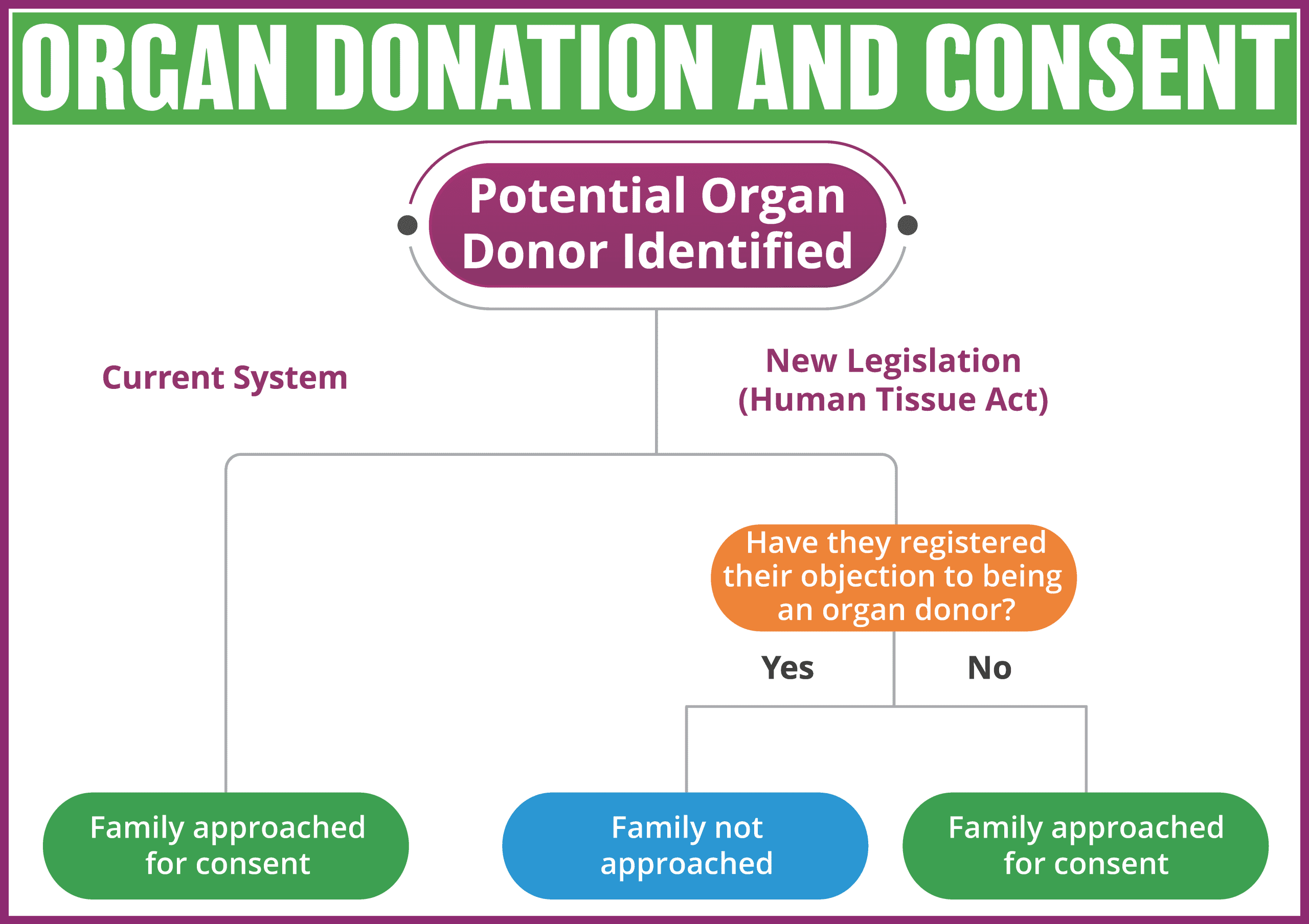
The legislation introduces an Opt-out Register that is operated by the HSE. If you choose not to be considered a potential organ donor, you can record your details on the Opt-out Register and your wishes are protected as a point of law. Under the new legislation, if a potential donor is identified, the healthcare professional will first check the Opt-out Register to see if the potential donor has registered their objection.
If the potential donor has registered their decision on the Opt-out Register, the family will not be approached and organ donation will not take place.
If the potential donor has not registered their decision on the Opt-out Register, the family will be approached to be asked if their loved one would have had any objection to organ donation going ahead.
How will the legislation operate in practice?
The HSE has created a Frequently Asked Questions section on its website, addressing many common queries and concerns about the new legislation.
Recognising Misinformation
Stay informed by learning how to recognise and avoid misinformation about organ donation, so your views are guided by clear, trustworthy information.
The Role of The Family
It has always been the case that in the event that someone is identified as a potential organ donor (they have been declared brain-stem dead when on a life-support machine in an Intensive Care Unit) their family is approached for consent to retrieval of the organs for transplantation. This role remains with the commencement of the Human Tissue Act.
The Role of The Family
It has always been the case that in the event that someone is identified as a potential organ donor (they have been declared brain-stem dead when on a life-support machine in an Intensive Care Unit) their family is approached for consent to retrieval of the organs for transplantation. This role remains with the commencement of the Human Tissue Act.
Who Is a Designated Family Member?
A designated family member is someone who had a close relationship with the person before they died and can help communicate their wishes.
The person chosen should have had meaningful contact with the medical team and be able to help communicate the person’s wishes clearly.
The law also sets out an order of priority if more than one person could act as the designated family member.

The Role of the Family
When Someone May Not Be Able to Act As A Designated Family Member
This includes a husband, wife or civil partner of the person who has died if:
This includes anyone who does not have ability to give informed consent. For example, if the person:
Children under 18 are not counted when deciding who the ‘designated family member’ is.
The only exception is if the child under 18 is the parent of the person who has died. In that case, they can be the designated family member.
This applies where it is not reasonably possible to contact or talk to the person in the time available for a decision about organ donation to be made and acted on. If there is no realistic way to reach them in time, they will not be treated as the designated family member for that decision.
This applies where doctors cannot be sure what the person’s relationship is to the patient. If the relationship cannot be clearly confirmed, that person will not be treated as the designated family member.
Why the Family Conversation Matters
Under the Human Tissue Act 2024, every adult in Ireland is treated as having agreed to be a potential organ donor when they die, unless they have put their name on the Organ Donation Opt-Out Register, or are in one of the groups that are excluded.
However, this does not mean that families are left out of the process. In fact, families remain a key part of the decision. Even though consent is presumed, the medical team will always speak with the family before any donation goes ahead. No organs will be donated without this careful and respectful conversation.
The wishes of the person who has died should always be at the centre of any decision. The family’s role is to help the healthcare team understand and respect those wishes.

Organ Donation in Ireland – Statistics & Impact
Against the backdrop of the extraordinary thoughtfulness of organ donors and their families, the IKA is deeply concerned about the decline in transplant activity. Figures published by the HSE show that organ donation and transplantation in Ireland fell sharply in 2025, with 202 organ transplants carried out – the lowest total in five years and well below the five-year pre-pandemic average of 282.
| Deceased Donor Transplants | 2025 | Pre-Pandemic Average (2015-2019) |
|---|---|---|
| Kidney | 111 | 128 |
| Liver | 33 | 61 |
| Lungs | 15 | 35 |
| Heart | 9 | 16 |
| Pancreas | 5 | 2 |
| Deceased Organ Donors | 68 | 85 |
| Living Kidney Donors | 29 | 40 |
Organ Donation Stories

Father And Son Mark 10th Anniversary Of Life-saving Kidney Transplant With Fundraiser For Support Centre
As Father’s Day approaches, a Co. Monaghan father and son are celebrating a milestone that means more to them than…

Mullingar Woman Honours Sister Nicola’s Legacy During Organ Donor Awareness Week
Mullingar Woman Honours Sister Nicola’s Legacy During Organ Donor Awareness Week A Mullingar woman is sharing the story of her…

Father gets to spend Christmas Day with children thanks to kidney transplant
PRESS RELEASE 22 December 2025 Father gets to spend Christmas Day with children thanks to kidney transplant This Christmas will…
Organ Donation FAQs
Find clear answers to your questions about organ donation in our easy-to-search FAQ.
Get A Donor Card
The Organ Donor Card is a visual representation of your decision to give the ‘Gift Of Life’ in the event of your death.
Organ Donation & Transplant Ireland
Organ Donation and Transplant Ireland (ODTI) leads the national organ donation and transplantation programme in Ireland.