Follow us
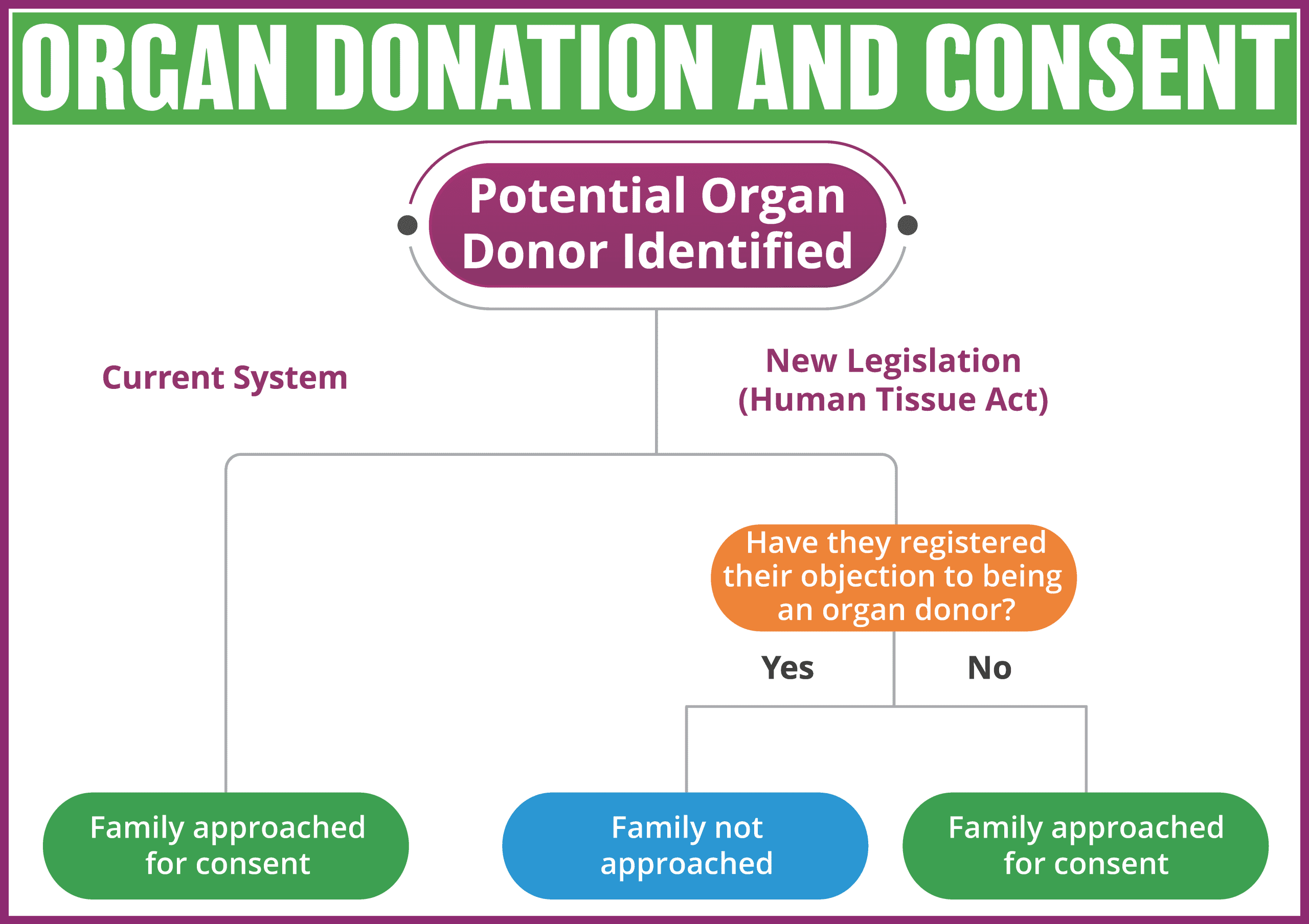
How Deemed Consent Actually Works
Where a person has not registered his or her objection to the donation of his or her relevant organs in accordance with section 33 , a registered medical practitioner who, after the person’s death proposes to remove a relevant organ from that person for the purposes of transplantation shall satisfy himself or herself that the designated family member of the person has confirmed that he or she does not have any objection to the donation of the relevant organ.
– Human Tissue Act (2024)
Organ Donation
Common Myths About Organ Donation
When you go to the hospital for treatment, the healthcare team tries to save your life, not someone else’s. You get the best care you can get.
Fact: This is a popular myth but in reality people don’t start to wiggle their toes after a healthcare provider says they’re dead. In fact, people who have agreed to organ donation are giv en more tests to make sure they’re dead than those who aren’t donating organs.
Fact: Most major faiths accept organ donation. These include Catholicism, Islam, Buddhism, most branches of Judaisim and most Protestant faits. Some religions believe organ donation to be an act of charity. If you don’t know where your faith stands on organ donation, ask a member of your clergy.
Fact: If you die before your 18th birthday, your parents or legal guardian will make the decision. If you want to be an organ donor, make sure your family knows your wishes. Remember, children too need organ transplants. They often need organs smaller than adult size.
Fact: Donors’ bodies are treated with care and respect. They are dressed for burial and no one can see that they donated organs or tissues.
Fact: There is no standard cutoff age for donating organs. The decision to use your organs is based on the health of your organs, not your age. Let the healthcare team decide at the time of your death whether your organs and tissues can be transplanted.
Fact: Very few medical conditions keep you from donating organs. Maybe you can’t donate some organs but other organs and tissues are fine. Let the healthcare team suggest at the time of your death whether your organs and tissues can be transplanted.
Fact: It is normal medical practice to vaccinate against infectious diseases prior to transplant surgery. For example, Hepatitus B and C are routinely vaccinated against prior to surgery.
Post transplant, patients take medication in order to reduce the risk of organ infection. This leads to a compromised immune system which reduces the ability to recover from infections.
There is overwhelming evidence that organ transplant recipients are extremely vulnerable to the COVID-19 virus with mortality rates of 20% recorded in many countries.
All patients suitable for transplantation will remain on the transplant programme regardless of their vaccination status. If they are called for an organ transplant, an individual risk assessment will be carried out to make sure the benefits of the surgery outweigh the risks.
Key Things To Remember
Further Information
Organ Donation Transplant Ireland
The official office of the HSE responsible for governing, leading, and integrating organ donation and transplantation
Beaumont Hospital Kidney Centre
The Beaumont Hospital Kidney Centre remains the largest provider of renal replacement therapy in the country.