Follow us
ORGAN DONOR CARD – THE FACTS
Frequently Asked Questions
Organ transplantation means the removal of an organ from one body and placing it in another body. Some organs can either be taken from a living person (LIVING DONOR), or from a patient who has died in hospital from some other cause (DECEASED DONOR).
For more information about organ transplantation and the Organ Donor card, click on the questions below:
Are all organs suitable for transplantation?
In general organs are suitable for transplantation if the person dies between the ages of 1 and 75 years. It is desirable that the person is free of significant and relevant general disease such as cancer, serious high blood pressure or, of course, any organ disease.
The usual circumstances are a sudden loss of consciousness such as may occur with a head injury, brain haemorrhage or brain tumour. The person must be alive when they reach hospital and in these circumstances they usually require artificial breathing support.
If further deterioration of the patient’s condition occurs and the brain actually dies, it is apparent that the person is dead even though artificial ventilation is continued. The next of kin’s permission is then sought to remove the organs for transplantation before the body is prepared for burial.
The fact of death of the brain is determined by the patient’s own doctors (not by any member of the Transplant Team) and it is helpful at this stage if the patient’s next of kin indicates to the doctor in charge that the patient wished their organs to be taken in these circumstances.
The kidneys are removed by the Transplant Team from Beaumont Hospital, Dublin where the operations are performed. The heart may be taken by the transplant team from the Mater Hospital and liver by a team from St. Vincents Hospital or by visiting UK teams. Eye donation is a more simple procedure and details may be obtained from the Eye Bank at Pelican House, Dublin.
Only when no suitable Irish recipients are identified are the organs retrieved for identified recipients in the UK.
How do religious groups feel about organ transplantation?
Leaders of all Christian and Jewish communities support organ donation as the greatest gift man can give to man. Hindu and Sikhs have no objections either.
What happens regarding organ donation if the donor dies in a country hospital, distant from the major medical centre where transplantation operations are carried out?
This will not necessarily prevent use of the organs for transplantation. Donor organs can be preserved for sufficient time for them to be transported to the transplantation centre.
How do I become a donor after my death?
Simply sign a Donor Card and request your next of kin to sign it also indicating their willingness to honour your wishes.
You may choose which organs you wish to donate. CARRY YOUR CARD WITH YOU AT ALL TIMES, so that in event of sudden untimely death you wishes become known immediately.
Organs are only taken from those who die in hospital, usually following admission in an emergency.
Do I need any medical test before signing a card?
No. But only entirely healthy organs are acceptable for transplantation.
How are the donor organs removed?
Donation is carried out in the hospital in which the patient dies. After the death of the donor, the organs are removed in an operating theatre, with precisely the same care as in any other surgical procedure.
What happens to a donors remains after organs have been removed?
Removal of organs and/or tissues authorised by a donor will not interfere with customary funeral or burial arrangements. These remain in the responsibility of relatives or persons in charge of estate.
What if I change my mind after signing a card?
Inform your family and tear up your card.
How can donor cards be obtained?
You can apply online via our form: CLICK HERE
Apply to the Irish Kidney Association at:
Irish Kidney Association
Donor House
Block 43A
Parkwest
Dublin 12.
Call: 01 620 5306
or ask your local pharmacy/medical centre.
The Role of the Family in Organ Donation
It has always been the case that in the event that someone is identified as a potential organ donor (they have been declared brain-stem dead when on a life-support machine in an Intensive Care Unit) their family is approached for consent to retrieval of the organs for transplantation. This role remains with the commencement of the Human Tissue Act.
The Donor Card
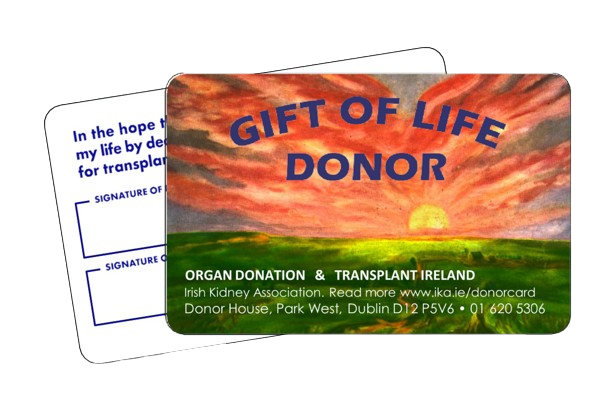
The Organ Donor Card is a visual representation of your decision to give the ‘Gift Of Life’ in the event of your death. By signing the card and carrying it with you, you are documenting your wishes to be an organ donor.
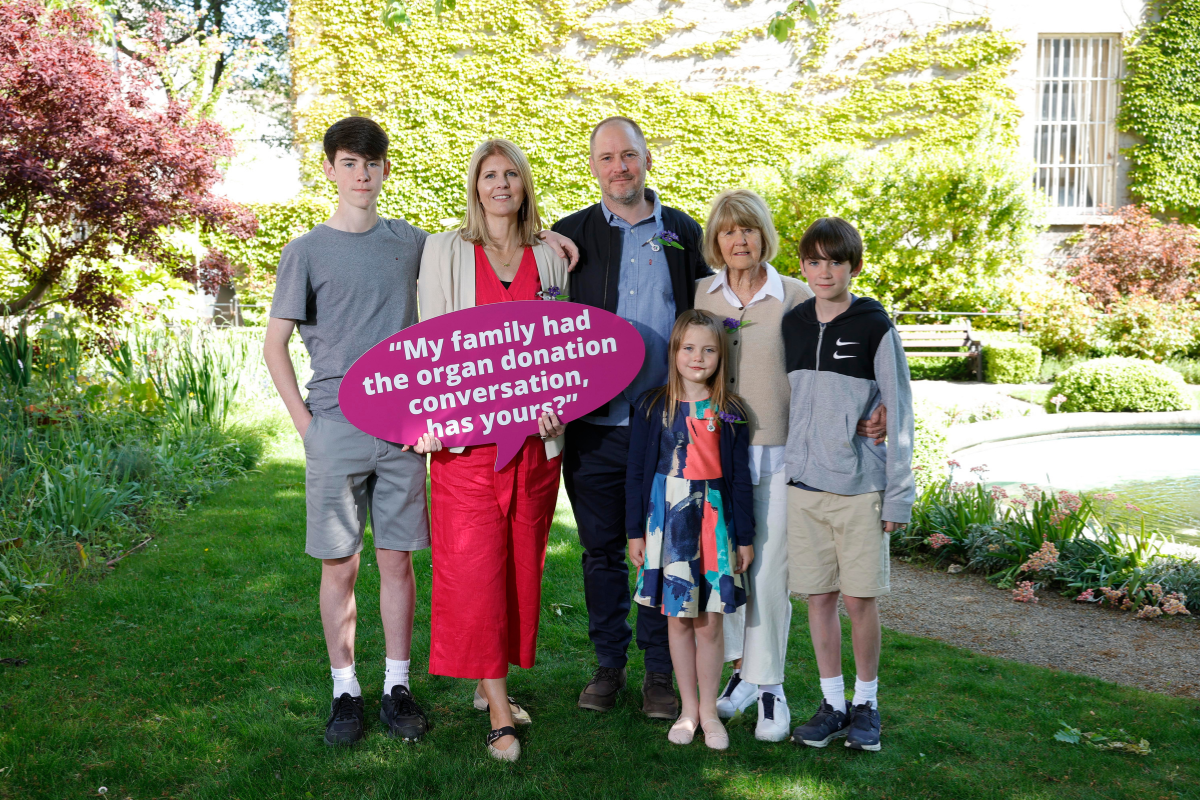
The card plays an important role in initiating the ‘Organ Donation Conversation’ with your loved ones. Discussing your wishes openly ensures that your family understands and honours your decision.
Organ Donation In Ireland
Learn more about the process and benefits of organ donation.
Organ Donation
Learn more about organ donation and The Human Tissue Act
Frequently Asked Questions
Explore FAQs covering Organ Donation, Transplantation, and Organ Donor Cards.
Resources
Download presentations and Human Tissue Act Resources
Education Pack
Bring Organ Donation Into Education
An education pack, including video, developed by students from
Eureka Secondary School in Kells, Co. Meath is available.